Thank you for visiting!
These motors are in use in personal locomotives; e.g., I know they work for O scale locos.
All motors are factory new, have been stored so they do not touch another motor or a metal surface (legend says that protects the magnets), and except for some Canon motors below are un-unused. I verify that they work properly (run smoothly and have what my experience tells me is appropriate power for that motor), and pack them carefully for shipping. They are shipped with delivery confirmation, and no refunds are given if the motor is not received (take the issue up with the shipper you told me to use).
If you buy a motor from me, please be sure to read Usage Information at the bottom of this page regarding care and handling of your motor. If you have any questions about what you read there, please contact me first before doing anything!
Because of the wide variety of uses for these motors, I have not compiled all the specification data into a matrix that allows easy comparison among all the motors.
| Ordering ID | OD | Len. | Ball brgs? | Tabs | Shaft L | 2nd Shaft L | Shaft Dia. | New | 12V RPM |
|---|---|---|---|---|---|---|---|---|---|
| FN30-1 | 30MM (1.17") | 37MM (1.443") | Yes | Side | 16MM (.624") | 11MM (.429") | 4MM (.156") | New | *** |
| FN30-2 | 30MM (1.17") | 41MM (1.6") | No | End | 13MM (.507") | 4MM (.156") | Used | About 6000* | |
| FN30-3 | 30MM (1.17") | 46MM (1.794") | Yes | End | 12MM (.468") | 4MM (.156") | New | *** | |
| FN30-4 | 30MM (1.17") | 50MM (1.95") | No | Side | 10MM (.39") | 7MM (.273") | 4MM (.156") | New | *** |
| FN35-1 | 35MM (1.365") | 32MM (1.25") | No | End | 11MM (.429") | 3MM (.118") | Used | *** |
* Speed was measured using a hand held tachometer.
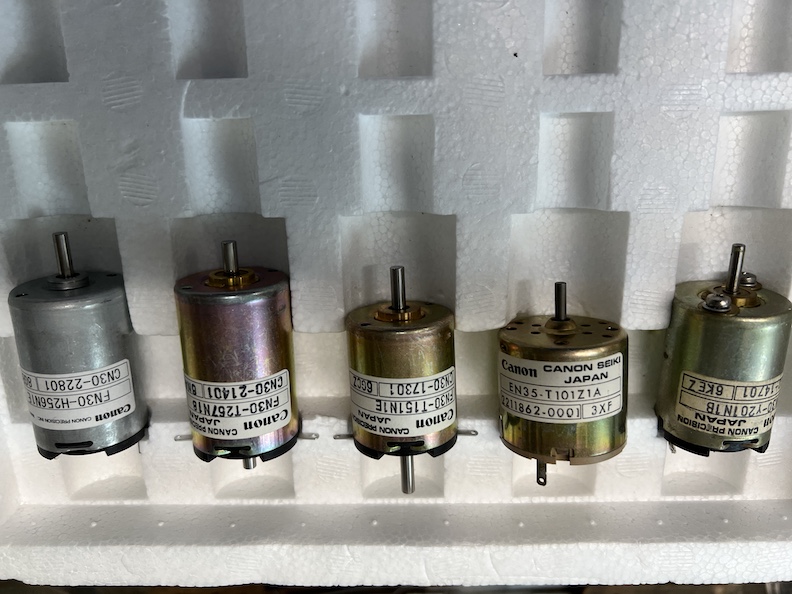
In the below photo the motors are left to right FN30-3, FN30-4, FN30-1, FN35-1, and FN30-2.
*** The motor speed at 12VDC is being researched.
I have used the FN30 motors in O scale models with Soundtraxx 2 amp decoders and found the models' speeds on typical layouts is satisfactory.
Please contact me if you have questions.
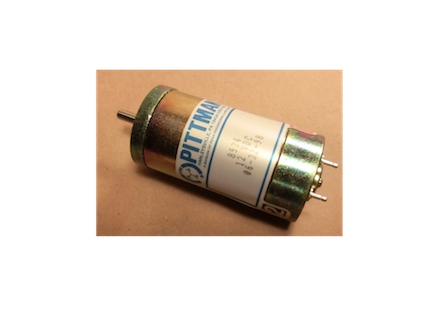
Pittman motors similar externally to the above motor are available from me. Please contact me for details on the motor sizes and availability.
Here are the specs for the 8524 motor. Source of the below data: Pittman spec. sheet dated 1993, specifications for currently produced motors are available from whoever owns the Pittman product, contact me if you need assistance. Other model motors in the 8000 series line will have slightly different performance specifications.
Length (front of housing to end of rear shaft protrusion): 2.511"
Diameter: 1.175"
Shaft length: .562"
Shaft Diameter: .156"
Features: neodymium magnets (more power for the size)
No load RPM: 10158
Stall Torque (oz-in): 16.8
Stall Current (amps): 10.3
DCC decoder considerations: I have not powered this motor with a decoder, however my
experience says that the NCE D408SR should
be OK. Minimum current capacity of a decoder with this motor is 2.5 amps, preferably 3+ amps;
Less powerful 8X1X Pittman motors overloaded a 1.5 amp decoder and worked OK with a 3 amp decoder.
Ignore what your panel meter shows, it doesn't show the current spikes.
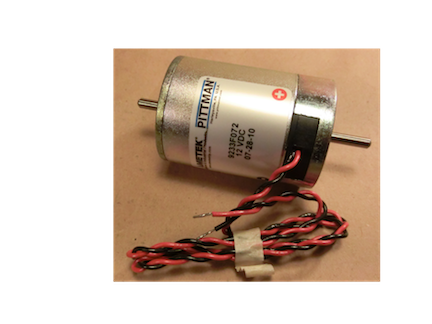
Pittman motors similar externally to the above motor are available from me. Please contact me for details on the motor sizes and availability.
Here are the specs for the 9233 motor. Source of the below data: Pittman spec. sheet dated 1993, specifications for currently produced motors are available from whoever owns the Pittman product, contact me if you need assistance. Other model motors in the 9000 series line will have slightly different performance specifications.
Source of the below data: Pittman spec. sheet dated 1992.
Length (front of housing to end of rear shaft protrusion): 2.329"
Diameter: 1.58"
Measured shaft length non-brush end: .500"
Measured shaft length brush end: .625"
Mounting screw in the ends of the cases: 6-32
Mounting screw bolt circle diameter: 1"
Shaft Diameter: .156"
Features: ball bearings, neodymium magnets (more power for the size)
No load RPM: 5993
Stall Torque (oz-in): 31.6
Stall Current (amps): 11.1
DCC decoder considerations: the comments for the 8524 above apply.
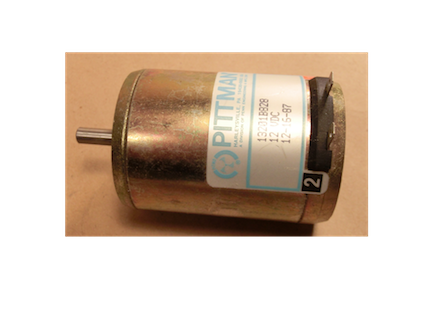
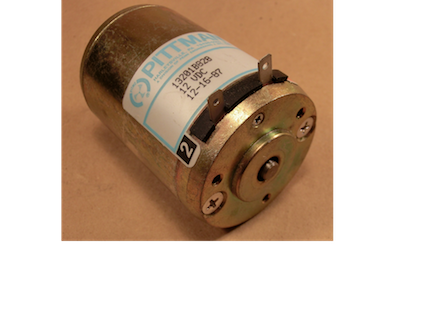
Source of the below data: Pittman spec. sheet dated 1981.
Length (front of housing to end of rear shaft protrusion): 3.084"
Diameter: 2.045"
Shaft length: .744"
Shaft Diameter: .249"
Features: ball bearings
No load RPM: 4620
Stall Torque (oz-in): 42.5
Stall Current (amps): 15.8
DCC decoder considerations: no recommendation, the NCE D808SR may work just fine.
Price: $75 each plus $10 S&H.
Notes:
1. Torque units conversions courtesy of the ASME conversion page at
http://www.engineersedge.com/torque_conversion.htm
I have a few motors that haven't been listed above because in many cases I have a few sometimes only one. Here's a photo of a sample of them. All these motors are 12 volt DC motors; all are new and unused, if a motor that matches your below specifications has been used I will test it and provide the results (noise, speed, amps when loaded and when not loaded) to you so you can make a decision to buy or not.
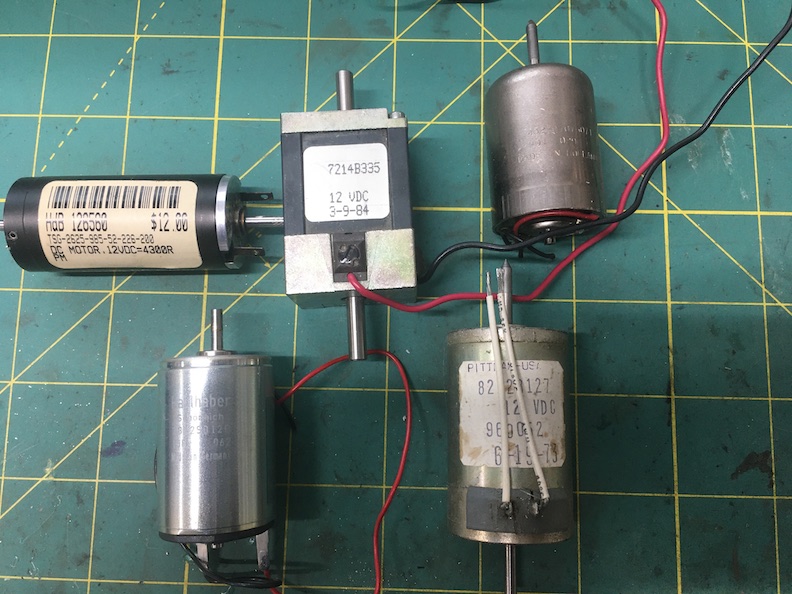
Here is some information about the above motors:
If you want to see if one of them could work for your application, please email me and be sure to include the following information:
If you don't know what you want please be respectful of my time.
I want to be helpful but if it appears the conversation isn't going
anywhere I will stop responding to you because it takes a non-trivial
amount of time to dig a specfic motor out so I can answer a question.
I won't attempt to identify a motor that will conform to vague
specifications.
Here are a few guidelines for use and care of your motor that will hopefully will enhance the value you receive from it.
The motor you purchased likely has ball bearings on the shafts if it was possible to obtain
motors with ball bearings. The ball bearings absorb end thrust on the
motor shaft. End thrust occurs when the motor's is connection to the locomotive's gear box shaft
doesn't absorb axial and pitch movement of the shaft.
A motor not equipped with ball bearings may run
slower in one direction than the other or make noise when running in either direction.
To eliminate this, you must isolate the motor shaft from the end thrust created by
the gearbox worm shaft. Some methods are to connect the motor and gearbox with a
coupling that will absorb the end play, or to have the motor shaft above or below
the gearbox shaft and connect the two shafts with a belt.
Alterations to the motor that make it not returnable even if it seems to run ok are:
My apologies for so many do's and don'ts. I want you to be successful with this motor, and if not,
for you to be able to get your money back. I trust you understand.
Interested in learning more about 2-rail O scale? Please visit the
O Scale Kings web pages.
Usage Information
Guidelines:
To bend the tabs on motors with tabs, place
narrow nose pliers on the tab and as close to where the tab enters the motor housing
and hold the tab in position as firmly as possible.
Use other pair of pliers and bend the tab without allowing the tab to move in the other pair of pliers.
Failure to bend the tabs using this procedure may change the orientation
of the brushes which are connected to the tabs, causing the motor to fail. I will not refund
or replace motors with bent tabs.
An alternative to bending the tabs is to shorten the tab by cutting the unwanted portion off
with a pair to cutters. Solder your connections to the remaining portion of the tab.
These web pages were designed and implemented by Rod Miller.
© 1998-2022 Rod Miller All Rights Reserved
Interested in learning more about 2-rail O scale? Please visit the O Scale Kings web pages.
These web pages were designed and implemented by Rod Miller.
© 1998-2025 Rod Miller All Rights Reserved